
- What it is
- On-site laying, jointing and pressure testing of glass-reinforced plastic pipelines and fittings.
- Best for
- Potable water, irrigation, drainage, sewage, cooling water and chemical or process lines.
- Key benefit
- Corrosion-free lines with low friction losses, installed right and proven by hydrotest.
- Typical scope
- Plant-room runs, buried mains, tie-ins and complete networks
- Where we work
- Dubai, Abu Dhabi, Sharjah, Ajman, Umm Al Quwain, Ras Al Khaimah and Fujairah
- Next step
- Free site inspection and a written, itemised quotation
GRP pipe installation in Dubai by specialists, since 2006
ESA Technical Services LLC is a Dubai-based technical services company, established in 2006, specialising in GRP works, waterproofing, insulation and installation across the UAE. GRP pipe installation in Dubai is one of our core services for main contractors, MEP contractors, utilities and industrial clients.
The UAE is hard on pipes. Aggressive soils, saline groundwater, high temperatures and chemical process fluids quickly corrode steel and ductile iron. GRP pipe doesn't rust, but it is a flexible pipe: its long-term performance depends on the bedding and backfill that support it and on correctly made joints. That is exactly where experience matters.
What is GRP pipe installation?
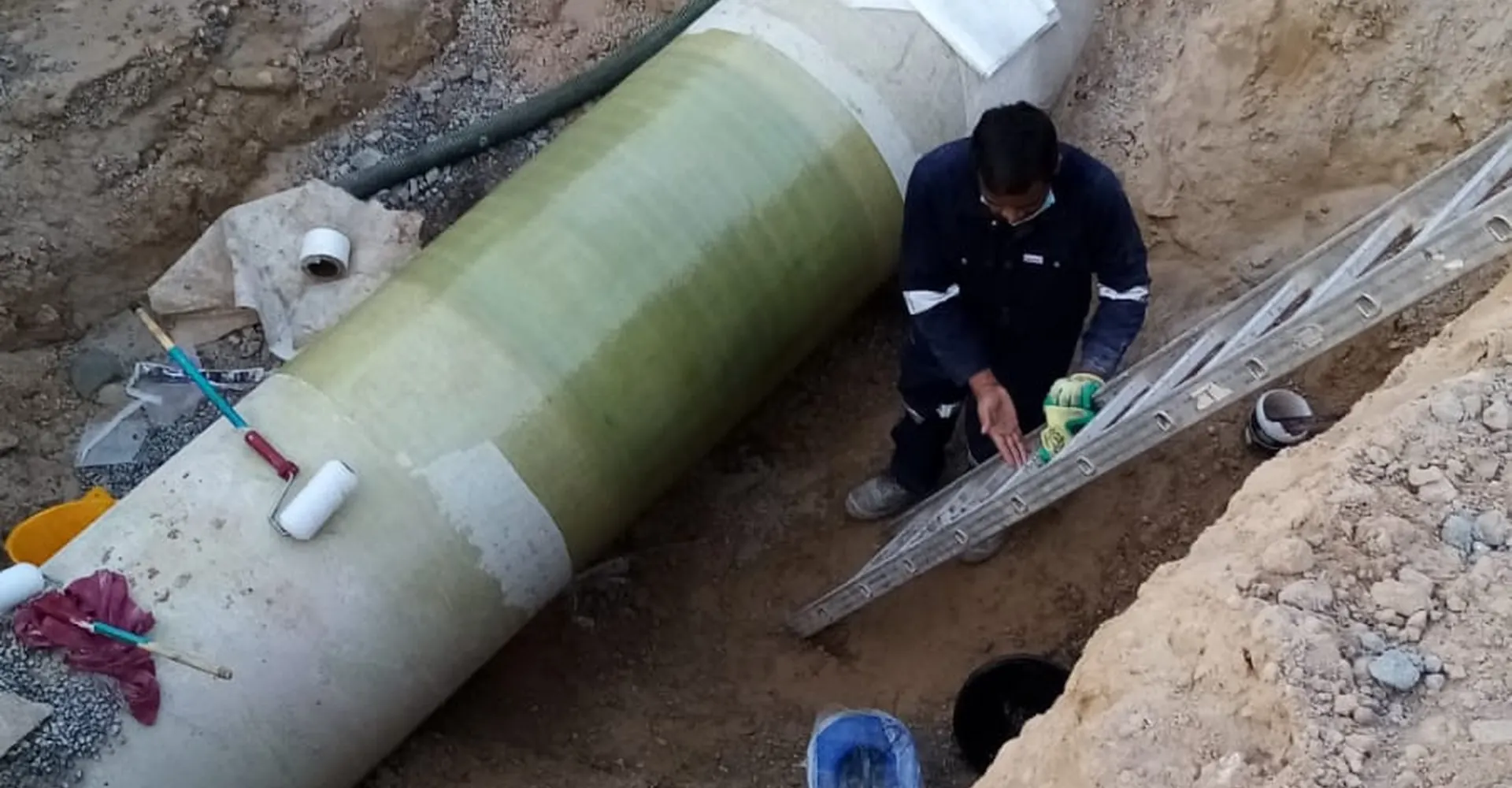
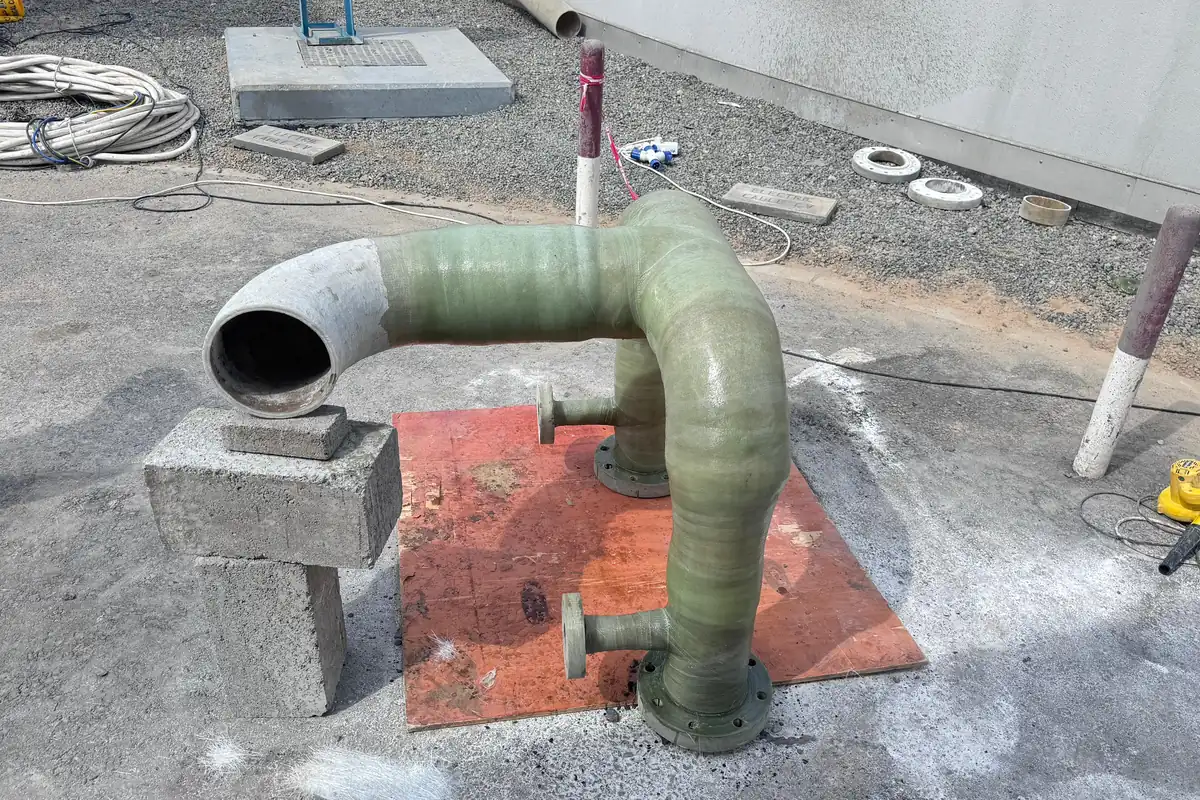
GRP pipe installation is the process of laying glass-reinforced plastic pipes on prepared bedding, aligning and jointing them (with gasketed couplings, flanges or laminated butt & wrap joints), supporting them correctly, and then hydrostatically testing the completed line to prove it's leak-free before backfilling or commissioning.
Unlike rigid concrete or ductile iron pipe, GRP relies on the surrounding soil for part of its strength. The installer's job is to control deflection (how much the pipe ovalises under load), keep joints within their allowable angular deflection, and avoid point loads from rocks or poor compaction. Manufacturers publish installation guides for this, and industry practice such as AWWA Manual M45 provides the framework. We follow the guide for the pipe you've bought.
When do you need grp pipeline installation?
These are the signs and project triggers we see most often on UAE sites:
- New infrastructure or building projects. Water, drainage or sewage networks where GRP has been specified for corrosion resistance
- Replacing corroded steel or ductile iron. Especially near the coast, in saline soils or for seawater and treated effluent
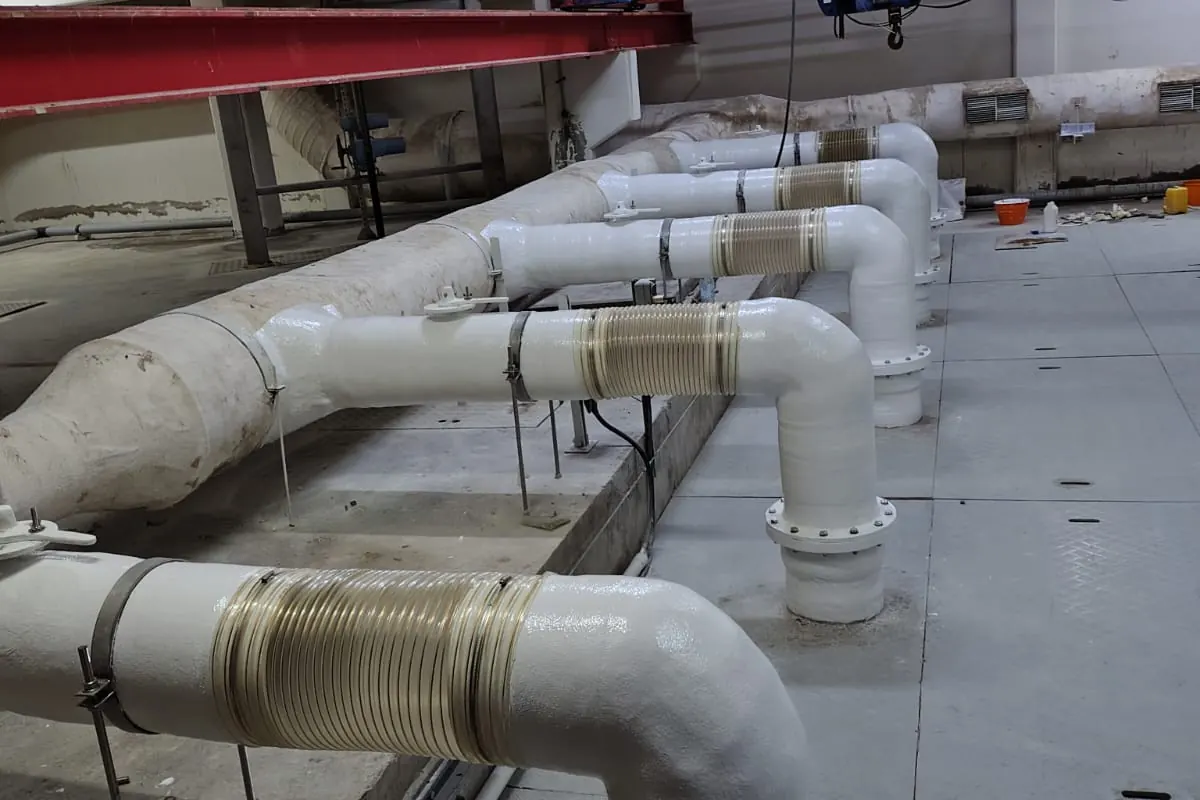
- Plant-room and above-ground lines. Pump rooms, chillers, cooling towers and process areas that need support and expansion detailing
- Tie-ins to existing GRP networks. New branches, valves and fittings added to live systems
- Industrial and chemical service. Process water, brine and chemical lines where the resin must match the fluid
Our step-by-step grp pipeline installation process
Survey and drawing review
We review drawings, pipe schedule, pressure class and stiffness, and inspect the trench, route and access. Clashes, support positions and tie-in points are agreed before materials arrive.
Receiving and handling
Pipes and fittings are inspected on delivery for impact damage, stored on timber supports away from direct sun where possible, and lifted with fabric slings, never chains or forks against the pipe.
Trench and bedding preparation
The trench bottom is checked for width, depth and stability, then a granular bedding layer is placed and compacted to the specified thickness so the pipe is evenly supported along its length.
Laying and alignment
Pipes are lowered in, aligned to line and level, and set so joints stay within the manufacturer's allowable angular deflection. Bell holes are formed so the pipe barrel, not the coupling, carries the load.
Jointing
Joints are made to the specified method: gasketed double-bell couplings or bell & spigot with lubricated elastomeric seals, bolted flanges torqued in sequence, or laminated butt & wrap joints built up and cured on site.
Thrust restraint and supports
Thrust blocks or restrained joints are provided at bends, tees and valves. Above ground, supports and guides allow for thermal expansion without point loading.
Haunching and backfill
Side fill is placed and compacted in layers to the specified density, and deflection is checked on flexible pipes, so the pipe is supported without distortion.
Hydrostatic testing and handover
The line is filled, air is vented and the test pressure is held for the specified period. Results, joint records and as-built notes are handed over with the completed section.
Technical specifications
Values below are typical ranges. Final specifications are confirmed per project from drawings, operating conditions and the manufacturer's technical data sheets.
| Parameter | Typical specification |
|---|---|
| Pipe types | Filament-wound or centrifugally cast GRP pipes and fittings |
| Diameters | Small-bore plant-room lines to large-diameter mains, per project schedule |
| Pressure classes | Gravity (non-pressure) to pressure classes such as PN6–PN25, per design |
| Stiffness classes | Typically SN2500, SN5000 or SN10000, selected for burial depth and loads |
| Joint types | Double-bell coupling with EPDM seals, bell & spigot, flanged, butt & wrap laminated, restrained joints |
| Resin systems | Isophthalic polyester (general water), vinyl ester (chemical / seawater), potable-grade systems |
| Reference standards | Manufacturer's installation guide; AWWA C950 / M45, ISO 10639, ISO 10467, BS EN 1796 as specified |
| Deflection check | Within the manufacturer's allowable limits (often around 3% initial) |
| Hydrostatic test | Typically 1.5 × design pressure (or per specification), held for the specified period |
Materials and methods
- Pipes and fittings: supplied by the project or sourced to your specification from established GRP manufacturers
- Bedding and backfill: clean granular material within the grading limits in the installation guide, compacted in layers
- Elastomeric seals and lubricants: EPDM (or as specified) gaskets with the manufacturer's approved lubricant only
- Laminating materials: chopped strand mat, woven roving and resin matched to the pipe's resin system for butt & wrap joints
- Test equipment: calibrated pressure gauges and recorders, with pumps and venting arranged to remove trapped air
Benefits of grp pipeline installation
No corrosion
GRP doesn't rust or tuberculate, so it keeps its bore and strength in saline soils and aggressive water, avoiding the steady decline typical of unprotected steel.
Lower pumping costs
The smooth internal surface keeps friction losses low for the life of the pipe, which reduces pumping energy compared with rougher materials.
Faster installation
GRP is light, so longer lengths can be handled with smaller equipment. That speeds up laying and reduces crane time on congested Dubai sites.
Resin matched to the fluid
Choosing the right resin, isophthalic, vinyl ester or potable grade, means the pipe suits the exact service, from drinking water to brine.
Proven at handover
Every section is hydrostatically tested and recorded, so you receive evidence, not assumptions, before the trench is closed.
Easy to repair later
If a GRP line is ever damaged, it can be repaired in place by lamination. We offer that service too.
Applications across the UAE
| Sector | Typical application | Why it fits |
|---|---|---|
| Utilities & infrastructure | Potable water mains, irrigation, treated sewage effluent (TSE) | Corrosion-free with a long design life |
| Drainage & sewage | Gravity sewers, storm drainage, force mains | Resists H₂S-related corrosion that attacks concrete |
| District cooling & HVAC | Condenser water, cooling tower lines | No internal corrosion products fouling heat exchangers |
| Industrial & petrochemical | Process water, brine, firewater, chemical lines | Resin selected for chemical and temperature resistance |
| Desalination & seawater | Intake and outfall lines, brine discharge | Handles seawater without cathodic protection |
| Buildings | Plant-room pipework, rooftop tank connections | Lightweight, low maintenance |
GRP vs steel vs ductile iron pipe
| Factor | GRP | Carbon steel | Ductile iron |
|---|---|---|---|
| Corrosion | None (resin-dependent) | Needs lining, coating and often cathodic protection | Needs lining and external protection |
| Weight | Light | Heavy | Very heavy |
| Hydraulics | Very smooth bore | Deteriorates with corrosion | Good when lined |
| Installation sensitivity | Needs good bedding and backfill | Tolerant, but welding needed | Tolerant |
| Typical use in UAE | Water, sewage, cooling, seawater | High pressure / high temperature | Water mains |
Quality control and safety
- Material inspection on arrival and damage records before installation
- Bedding thickness, compaction and trench checks at hold points
- Joint records: gasket position, flange torque sequence, laminate dimensions
- Deflection measurements on buried flexible pipe where specified
- Hydrostatic test with calibrated gauges, pressure logged and signed off
- Trench safety, lifting plans, permits and PPE under the site HSE plan
Why choose ESA for grp pipeline installation
- Pipe specialists since 2006. We've installed and repaired GRP lines across the UAE for nearly two decades
- We laminate too. Butt & wrap joints and tie-ins are made by our own laminators, not a separate subcontractor
- Manufacturer-led method. We install to the guide for your pipe, so the manufacturer's requirements are met
- Tested and documented. Every section is handed over with test records
- UAE-wide mobilisation. Crews available across all seven Emirates
GRP Pipeline Installation: frequently asked questions
How long does GRP pipe installation take?
It depends on length, diameter, depth, jointing method and access. Short plant-room runs can take days, while buried mains are phased over weeks. Laminated joints need curing time before testing, which we build into the programme.
What test pressure do you use for GRP pipes?
We test to the project specification. A common approach is around 1.5 times the design pressure, held for a defined period, but consultants and manufacturers may specify differently. The test is always recorded.
Can GRP pipe be installed in high groundwater?
Yes, with dewatering during installation and attention to flotation. Empty GRP pipe is light, so backfill depth, anchoring or restraint must be sufficient to prevent uplift.
Do you supply the pipes?
We can install pipes supplied by the project or coordinate supply from established manufacturers to your specification.
Who needs GRP pipe installation near me in Dubai?
Main contractors, MEP contractors, developers, utilities and industrial plants use our service across Dubai, from Jebel Ali and Dubai Investments Park to Al Quoz, and in every other Emirate.
Written by the ESA Technical Services teamLast updated: