
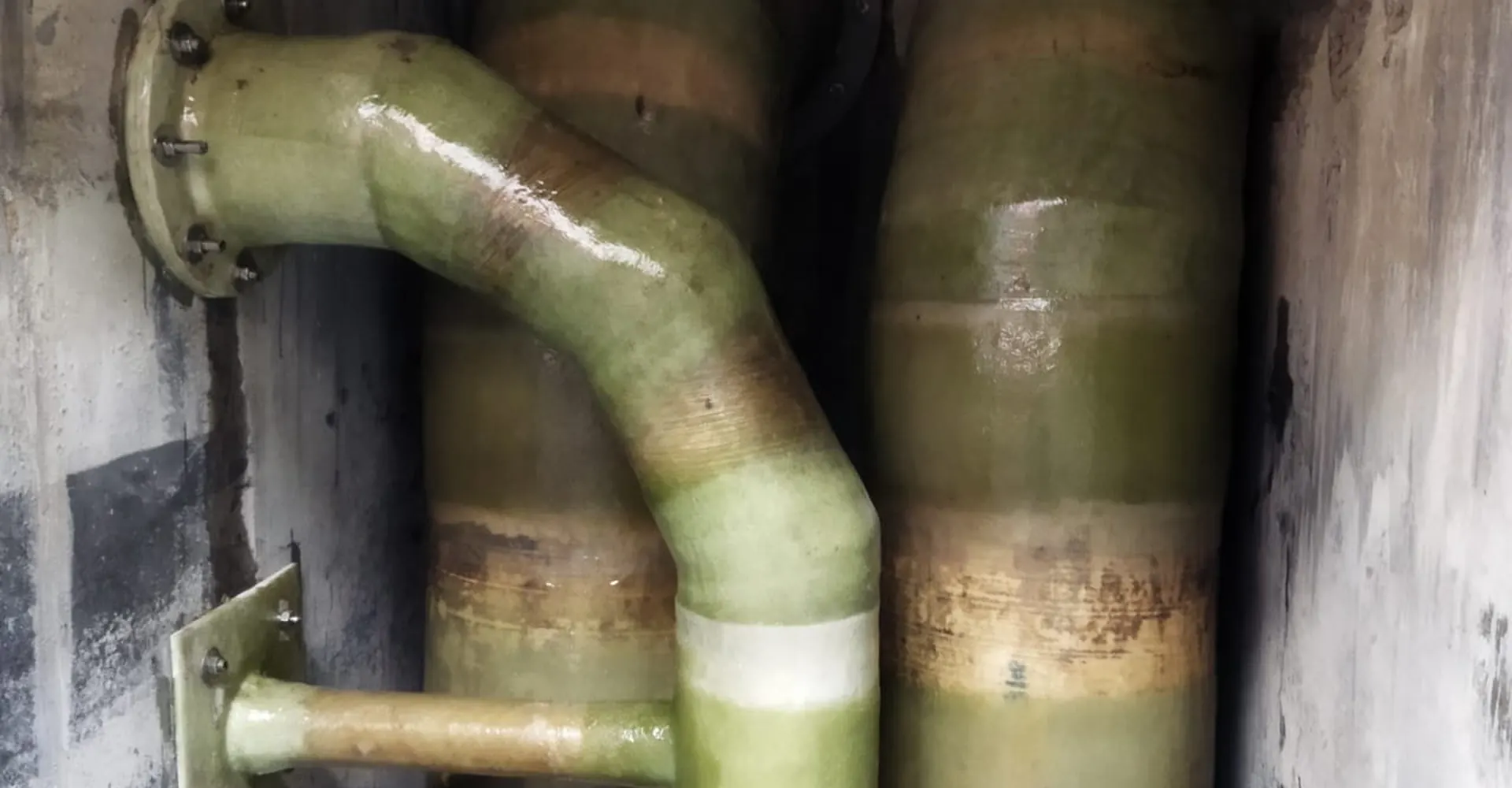
- What it is
- Locating, isolating and permanently repairing leaks in GRP pipelines by grinding out and re-laminating the defect.
- Best for
- Leaking joints, cracks, impact damage and weeping sections on live networks.
- Key benefit
- Stops the leak permanently and returns the line to service quickly.
- Urgent work
- Priority attendance for active leaks
- Where we work
- Dubai, Abu Dhabi, Sharjah, Ajman, Umm Al Quwain, Ras Al Khaimah and Fujairah
- Next step
- Free site inspection and a written, itemised quotation
GRP pipe leak repair in Dubai and across the UAE
ESA Technical Services LLC is a Dubai-based technical services company, established in 2006, specialising in GRP works, waterproofing, insulation and installation across the UAE. Our GRP pipe leakage rectification service is used by FM companies, utilities, contractors and plant operators when a line starts leaking.
A leak is a symptom. A clamp may stop it for now, but if the cause is ground movement, a failed joint, a pressure surge or the wrong resin, the leak will return, often nearby. Our approach is to diagnose first, then repair in a way that addresses the cause.
What is GRP pipe leakage rectification?
GRP pipe leakage rectification is the diagnosis and permanent repair of leaks in glass-reinforced plastic pipelines. The leak is located and the section isolated and dried, then damaged laminate is ground out and new reinforcement and resin are laminated over the area. The repaired line is cured and re-tested before returning to service.
Temporary measures such as repair clamps or wraps have their place in an emergency, and we can provide them. But a permanent repair restores the pipe's laminate structure, so it is designed to last as long as the pipe around it.
When do you need grp pipe leakage rectification?
These are the signs and project triggers we see most often on UAE sites:
- Visible leaks or wet patches. Water surfacing above a buried line or dripping from a joint
- Unexplained water loss. Meter readings or tank levels that don't add up
- Weeping through the pipe wall. Fine seepage that can indicate cracking or chemical attack
- Failed hydrotest. New installations that won't hold pressure
- Impact or excavation damage. Pipes hit during other works
- Recurring leaks at clamps. Temporary repairs that keep failing
Our step-by-step grp pipe leakage rectification process
Leak location
We trace the leak from symptoms, pressure behaviour and inspection. On buried lines this may involve exposing the pipe at the likely location.
Isolation and draining
The section is isolated, depressurised and drained. The repair area is dried, because moisture is the main enemy of a good laminate bond.
Root-cause assessment
We examine the failure: joint workmanship, cracking pattern, deflection, bedding loss, chemical damage or impact. This decides the repair method and prevents a repeat.
Grinding out damage
Damaged or delaminated material is ground back to sound laminate, with the preparation zone extended onto healthy pipe on all sides.
Repair lamination
New reinforcement layers are laminated over the prepared area to the required thickness and overlap, with tapered edges. Resin matches the pipe's service.
Correcting the cause
Where the cause is external, such as lost bedding or missing support, we reinstate bedding, add supports or recommend changes.
Cure, test and return to service
Once cured, the repaired section is pressure tested or leak-checked, recorded, and returned to service.
Technical specifications
Values below are typical ranges. Final specifications are confirmed per project from drawings, operating conditions and the manufacturer's technical data sheets.
| Parameter | Typical specification |
|---|---|
| Typical defects | Joint leaks, cracks, impact damage, delamination, weeping |
| Temporary options | Repair clamps or wraps for emergency containment, where suitable |
| Permanent repair | Ground-out and re-laminated section, or cut-out and spool replacement with laminated joints |
| Resin | Matched to the original pipe (isophthalic, vinyl ester, epoxy) |
| Surface condition | Dry, clean, abraded; moisture controlled with heaters/blowers where needed |
| Verification | Thickness, visual, cure check; hydrostatic or service leak test |
Materials and methods
- Repair reinforcement: mat and woven roving layers sized to the defect and pipe class
- Resins and putties: compatible with the existing pipe and the fluid
- Drying equipment: heaters and air movers to remove moisture from the repair zone
- Temporary clamps: for emergency containment until the permanent repair window
Benefits of grp pipe leakage rectification
Short shutdowns
Targeted repairs mean the line is out of service for hours or days, not weeks.
Root cause fixed
Diagnosing why it leaked prevents repeat failures and repeat call-outs.
Lower cost than replacement
Repairing a section avoids large excavations and new pipe.
Water saved
Stopping losses quickly protects supply and avoids damage to structures and roads.
Permanent result
A properly bonded laminate is designed to last as long as the surrounding pipe.
Documented
Each repair is recorded with photos, cause, method and test result.
Applications across the UAE
| Sector | Typical application | Why it fits |
|---|---|---|
| FM & buildings | Plant-room and riser GRP lines | Fast repair with minimal disruption to occupants |
| Utilities | Buried water and sewage mains | Targeted excavation and repair |
| Industrial | Process and cooling water lines | Repair within planned shutdowns |
| District cooling | Condenser water and cooling tower lines | Restores reliability of critical systems |
| Contractors | New lines failing hydrotest | Diagnose and correct before handover |
Clamp vs permanent lamination repair
| Factor | Repair clamp (temporary) | Lamination repair (permanent) |
|---|---|---|
| Speed | Very fast | Hours to a day, plus cure |
| Shutdown needed | Sometimes not | Yes (dry surface) |
| Durability | Short to medium term | Designed as permanent |
| Addresses cause | No | Yes, with root-cause assessment |
| Best use | Emergency containment | Lasting repair |
Quality control and safety
- Isolation, permit-to-work and draining confirmed before work
- Moisture checks on the repair zone before lamination
- Grind-back extent and preparation inspected
- Layer count, thickness and overlap measured
- Cure check before pressurising
- Leak or pressure test recorded
Why choose ESA for grp pipe leakage rectification
- GRP repair specialists since 2006. Leak repair is daily work for our crews
- Diagnosis first. We fix the reason, not only the symptom
- Work planned around operations. Scheduled around your shutdown windows
- One team from locate to test. No hand-offs between trades
GRP Pipe Leakage Rectification: frequently asked questions
Can a GRP pipe be repaired while in service?
An emergency clamp can sometimes be fitted under reduced pressure, but a permanent laminate repair needs the section isolated, drained and dry so the laminate bonds and cures.
How long does a GRP leak repair take?
Many local repairs are completed in a single shift plus cure time. Larger or buried repairs take longer because of excavation and drying. We give a clear duration after inspection.
Why does my GRP pipe keep leaking in the same area?
Repeat leaks usually point to an unresolved cause, such as lost bedding, excessive deflection, movement at a thrust point, a pressure surge or chemical attack. We investigate these before repairing.
Do you offer emergency GRP leak repair?
Yes, we prioritise active leaks and can contain them temporarily while a permanent repair is planned.
Written by the ESA Technical Services teamLast updated: