
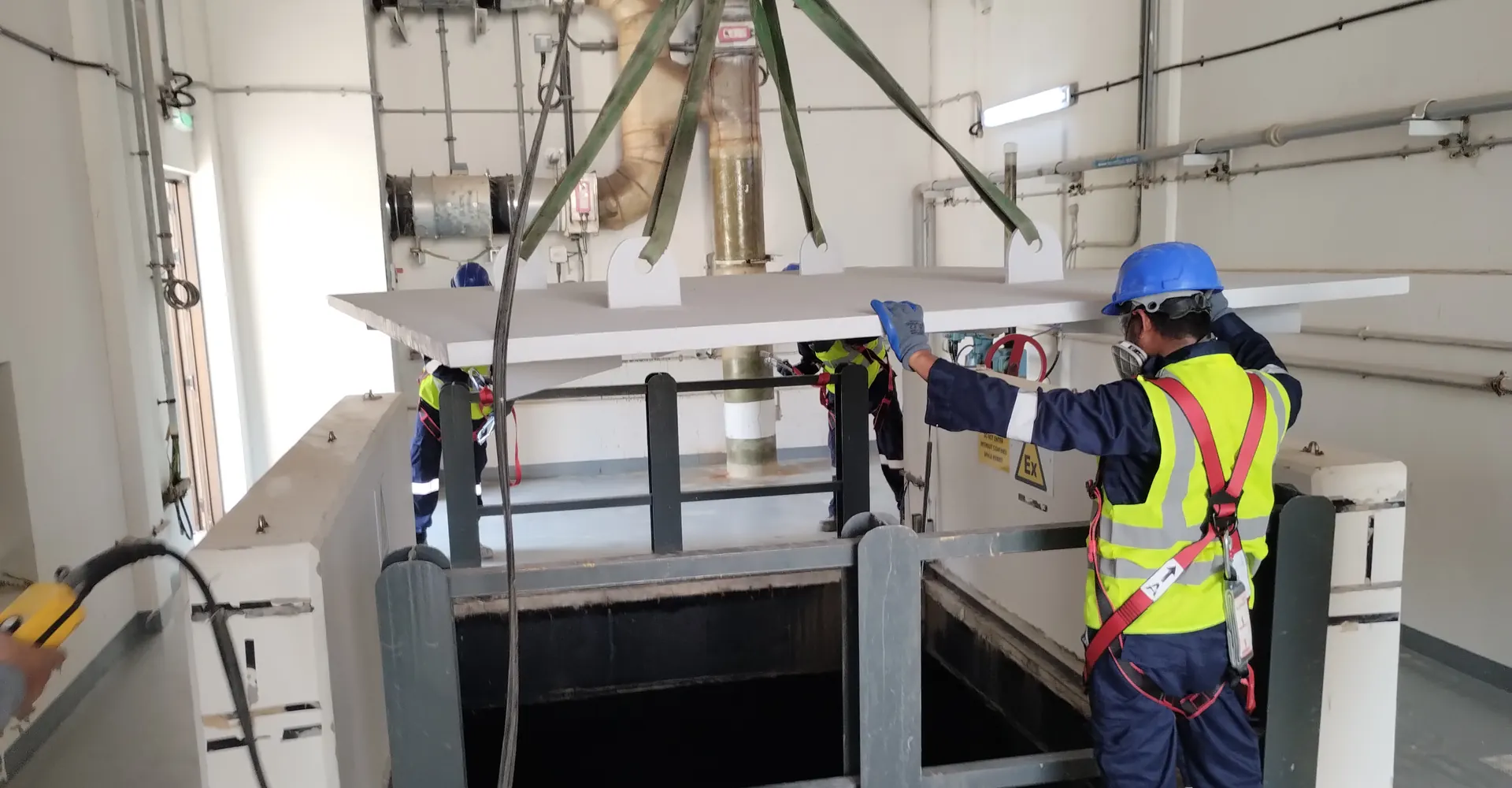
- What it is
- Installing flat GRP plates with a pattern of holes, used to distribute flow, support media, screen solids or provide ventilation.
- Best for
- Water tanks, filters, treatment plants, cooling towers, scrubbers and industrial process equipment.
- Key benefit
- Corrosion-free performance in wet and chemical service.
- Formats
- Moulded or fabricated GRP sheets with specified hole size and open area
- Where we work
- Dubai, Abu Dhabi, Sharjah, Ajman, Umm Al Quwain, Ras Al Khaimah and Fujairah
- Next step
- Free site inspection and a written, itemised quotation
GRP perforated plate installation in the UAE for water and process systems
ESA Technical Services LLC is a Dubai-based technical services company, established in 2006, specialising in GRP works, waterproofing, insulation and installation across the UAE. GRP perforated plate installation in the UAE is a specialist task we carry out for water treatment, tank and industrial clients.
Perforated plates often sit inside equipment that is hard to reach once commissioned, such as filters, tanks and scrubbers. In corrosive, wet conditions, mild or galvanised steel plates corrode and shed debris into the water. Glass-reinforced plastic plates avoid that and are light enough to handle through manholes.
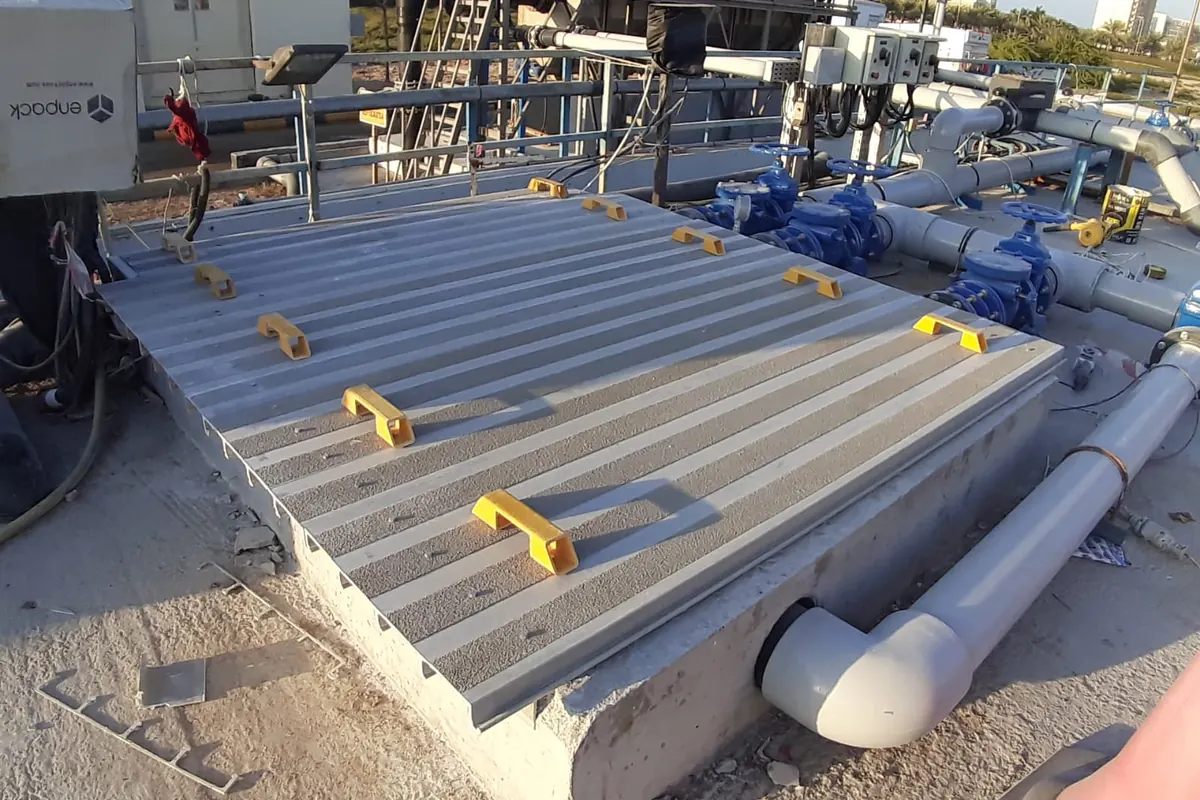
What is a GRP perforated plate?
A GRP perforated plate is a flat panel of glass-reinforced plastic with a regular pattern of holes of a specified size and spacing (open area). It's used to distribute or straighten flow, support filter media or packing, screen solids, or allow air or water to pass while providing a solid, corrosion-resistant barrier or platform.
The hole size, pitch and open area are chosen by the process designer. Our job is to install the plates accurately: supported at the right spans, level, sealed at the edges where bypass must be avoided, and fixed with corrosion-resistant fasteners.
When do you need grp perforated plate installation?
These are the signs and project triggers we see most often on UAE sites:
- Filter underdrains and media support. In water treatment filters and vessels
- Flow distribution in tanks. Inlet diffusers and flow straighteners
- Cooling towers and scrubbers. Distribution decks and support plates
- Screens and guards. Where solids must be retained but water or air passes
- Replacing corroded steel plates. Upgrading to GRP during maintenance shutdowns
Our step-by-step grp perforated plate installation process
Design review
We review drawings for hole pattern, open area, plate thickness, spans and support details, and confirm dimensions on site.
Access and safety
Equipment is isolated and drained. Confined-space permits and ventilation are arranged for internal work.
Support preparation
Existing supports are cleaned and inspected, and new GRP or stainless supports are installed where needed so plates are supported at the design spans.
Cutting and fitting
Plates are cut to size and openings formed for pipes or access. Cut edges are sealed with resin to protect exposed fibres.
Placement and levelling
Plates are positioned, levelled and aligned so flow distributes evenly with no gaps for bypass.
Fixing and sealing
Plates are fixed with stainless steel or GRP fasteners, and perimeter seals are installed where required.
Inspection and handover
Level, fixings, seals and hole alignment are checked and recorded before the equipment is closed and returned to service.
Technical specifications
Values below are typical ranges. Final specifications are confirmed per project from drawings, operating conditions and the manufacturer's technical data sheets.
| Parameter | Typical specification |
|---|---|
| Material | GRP (polyester or vinyl ester resin, per chemical exposure) |
| Thickness | Per design and span, commonly several mm to 20+ mm |
| Perforation | Hole diameter, pitch and open area per process design |
| Fasteners | Stainless steel (e.g. SS316) or GRP bolts |
| Edge treatment | Resin-sealed cut edges |
| Supports | GRP or stainless steel beams/angles at design spans |
Materials and methods
- GRP perforated sheets: moulded or fabricated to the specified pattern
- Support sections: pultruded GRP or stainless steel
- Fixings: corrosion-resistant bolts, washers and clips
- Sealing resin and gaskets: to seal edges and prevent bypass
Benefits of grp perforated plate installation
No corrosion
No rust or scale shedding into water or product.
Lightweight
Plates pass through manholes and can be installed by hand.
Chemical resistance
Vinyl ester options suit aggressive process chemistry.
Easy to modify
Plates can be cut on site for pipes and access openings.
Long service
Minimal maintenance compared with coated steel.
Accurate flow
Correct installation maintains design distribution.
Applications across the UAE
| Sector | Typical application | Why it fits |
|---|---|---|
| Water treatment | Filter underdrains, media support | Corrosion-free in constant immersion |
| Tanks | Inlet diffusers, flow distribution plates | Improves mixing, reduces short-circuiting |
| Cooling towers | Distribution decks | Resists treated water chemistry |
| Industrial scrubbers | Packing supports | Chemical-resistant |
| Sewage treatment | Screens and baffles | Handles aggressive environments |
Quality control and safety
- Dimensions verified on site before cutting
- Cut edges sealed
- Plate level and alignment measured
- Fixings torqued and checked
- Perimeter seals inspected
- Confined-space and isolation procedures followed
Why choose ESA for grp perforated plate installation
- GRP specialists since 2006. We understand the material inside and out
- Confined-space capable. Trained crews for internal equipment work
- Shutdown-friendly. Planned to fit maintenance windows
- Documented. Inspection records at handover
GRP Perforated Plate Installation: frequently asked questions
Why use GRP instead of stainless steel perforated plates?
GRP is lighter, often more economical, and resists chlorides and many chemicals that can pit stainless steel. The best material depends on the process, and we'll advise.
Can you make openings for pipes on site?
Yes. Openings are cut on site and the edges sealed with resin to keep the plate durable.
Do you supply the plates?
We can install client-supplied plates or coordinate fabrication to your drawings.
How long does installation take?
Usually within a planned shutdown, often a few days depending on plate area and access.
Written by the ESA Technical Services teamLast updated: